
Which Calgary communities get the most winter sun?
The short answer
Among 133 established Calgary communities in LandMood's model, newer suburbs tend to get the most winter sun and the inner city the least: communities built since 2000 get a median of about 2 h of direct sun on December 21 along their residential streets, while in 11 of 18 inner-city communities the median is under half an hour (typical year, 2016–2025).
The city-wide median is 1.3 h. These are medians of the ground along residential streets (boulevards, front yards and driveways as a band, never a single home), so they describe a community, not a house. The difference between two homes on the same street is often bigger than the difference between two communities. To see one home rather than a whole community, place it on the free map.
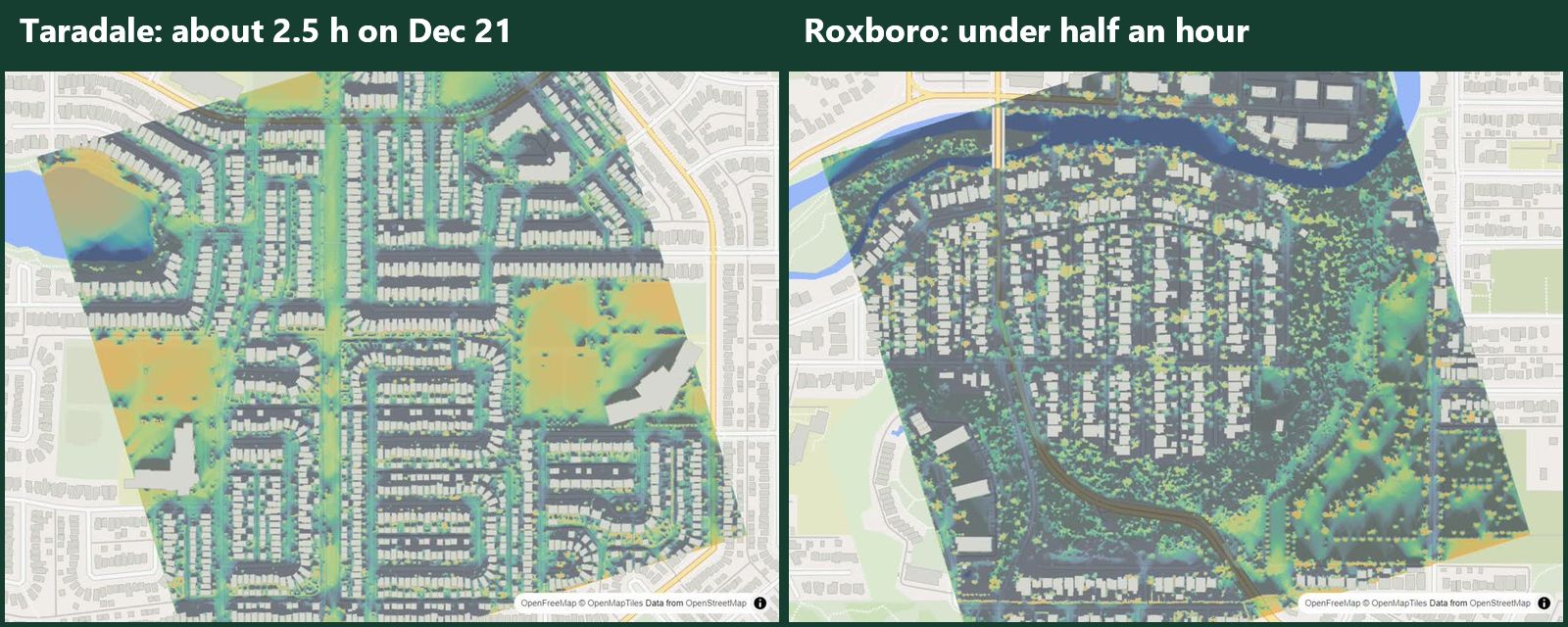
The 15 Calgary communities with the most December sun
| Rank (of 133) | Community | Direct sun on Dec 21 (median, street-side ground) | Street-side ground with under 30 min of sun |
|---|---|---|---|
| 1st | Greenwood/Greenbriar | about 6 h | about 10% |
| 2nd | Saddle Ridge | about 3 h | about 25% |
| 3rd | Taradale | about 2.5 h | about 30% |
| 4th | Rocky Ridge | about 2.5 h | about 30% |
| 5th | Shawnee Slopes | about 2.5 h | about 30% |
| 6th | Evanston | about 2.5 h | about 30% |
| 7th | Montgomery | about 2.5 h | about 35% |
| 8th | Vista Heights | about 2.5 h | about 30% |
| 9th | Falconridge | about 2.5 h | about 30% |
| 10th | New Brighton | about 2.5 h | about 35% |
| 11th | Royal Oak | about 2 h | about 35% |
| 12th | Panorama Hills | about 2 h | about 35% |
| 13th | Martindale | about 2 h | about 35% |
| 14th | Greenview | about 2 h | about 35% |
| 15th | Manchester | about 2 h | about 30% |
Greenwood/Greenbriar is far ahead of every other community in the model: almost all of its street-side ground gets more than two hours of direct sun on December 21. Most of the rest are suburbs built from the 1980s on, where trees are younger and fewer of them stand over the street-side ground.
The 15 Calgary communities with the least December sun
| Community | Direct sun on Dec 21 (median, street-side ground) | Street-side ground with over 2 h of sun |
|---|---|---|
| Bankview | under half an hour | about 20% |
| Cliff Bungalow | under half an hour | about 15% |
| Elbow Park | under half an hour | about 25% |
| Garrison Woods | under half an hour | about 25% |
| Lower Mount Royal | under half an hour | about 10% |
| Mount Pleasant | under half an hour | about 30% |
| Rideau Park | under half an hour | about 20% |
| Roxboro | under half an hour | about 10% |
| Scarboro | under half an hour | about 20% |
| Upper Mount Royal | under half an hour | about 25% |
| Bayview | under half an hour | about 25% |
| Highwood | under half an hour | about 30% |
| South Calgary | under half an hour | about 30% |
| Altadore | about 0.5 h | about 30% |
| Bel-Aire | about 0.5 h | about 25% |
13 communities have a median under half an hour, and 11 of them are inner-city communities, where mature trees and closely spaced homes shade the street-side ground for most of the short winter day.
Older communities get less winter sun
The City of Calgary records when most homes in each community were built. Grouped that way, the pattern in our model is steady: the older the community, the less December sun reaches the ground along its streets.
| When most homes were built (City of Calgary) | Communities | Direct sun on Dec 21 (median of the community medians) |
|---|---|---|
| Inner city (older homes, mature trees) | 18 | under half an hour |
| 1950s | 34 | about 1 h |
| 1960s and 1970s | 40 | about 1.5 h |
| 1980s and 1990s | 24 | about 1.5 h |
| 2000s | 11 | about 2 h |
| 2010s and 2020s | 5 | about 2 h |
Less sun, more snow in March
Snow follows the sun. Across all 133 communities, the ranking for March snow cover is close to the reverse of the ranking for December sun: the communities near the bottom of the sun table are near the top for snow still on the ground in March. Each community page shows its own snow and spring-melt numbers.
The bigger difference is between homes
A sunny community does not make a sunny house. Even in the 15 sunniest communities, about 30% of the street-side ground gets under half an hour of sun on December 21 (median of those communities). In the 15 least sunny, about 25% still gets more than two hours.
What decides a single home is mostly which way it faces and what stands to its south: a north-facing front with a two-storey house or a tall spruce across the yard can sit in shade all winter in any community. Read north-facing vs south-facing houses for what to look for at a viewing.
How these numbers are made
LandMood follows the sun hour by hour over 1-metre public lidar of the real houses and trees (Natural Resources Canada) with ten years of weather (2016–2025). For each community we sampled the ground along residential streets and open ground away from buildings across the whole community; new subdivisions where the lidar predates the houses are left out. Values are rounded to the nearest half hour. The Calgary communities page lists all 133 with their sun, snow and spring-melt numbers.
Questions people ask
Which Calgary communities get the most sun in winter?
In LandMood's model, newer suburbs lead: communities built since 2000 get a median of about 2 h of direct sun on December 21 along their residential streets, against 1.3 h for the median Calgary community. The full ranking of 133 communities is on this page.
Why do inner-city Calgary communities get less winter sun?
At noon on December 21 the sun is only about 15 degrees above the horizon in Calgary, so mature trees and closely spaced homes cast long shadows. In 11 of the 18 inner-city communities in our model, the median street-side ground gets under half an hour of direct sun on December 21.
Does a sunny community mean a sunny house?
No. Even in the 15 sunniest communities, about 30% of the ground along residential streets gets under half an hour of sun on December 21. Which way a home faces and what stands to its south matter more than the community. Check the specific home on the map.