
South-facing backyard in Canada: the pros, the cons and the trade-off at the front
The short answer
In Saskatoon and Calgary, a south-facing back yard is usually the sunniest part of the lot in winter and early spring, unless the house's own shape, a neighbour's house or tall trees to its south shade it. The trade-off is at the front: the front of the same house faces north and is usually shaded.
In Canada the winter sun travels low across the southern sky. At noon on December 21 it is only about 14° above the horizon in Saskatoon and 15° in Calgary, so a house casts a shadow about four times its height toward the north. Whatever is on the south side of a house gets the sun; whatever is on the north side sits in the house's shadow.
A south-facing back yard therefore usually gets the most winter and early-spring sun of any yard on the lot. There is one catch: if the back faces south, the front faces north, and that is where your driveway and front steps are.
What we measured in Calgary
We used LandMood's model, which places the sun hour by hour over 1-metre public lidar of the real houses and trees (Natural Resources Canada) and ten years of weather (2016–2025). In Calgary we sampled 149 homes in Signal Hill, Tuscany, Mahogany, Hillhurst and Edgemont and compared the front and back yards on the shortest day of the year.
| Front of the house faces | Front yard, Dec 21 (median) | Back yard, Dec 21 (median) |
|---|---|---|
| North (back yard faces south) | 0.2 h | 5.2 h |
| South (back yard faces north) | 3.3 h | 0.7 h |
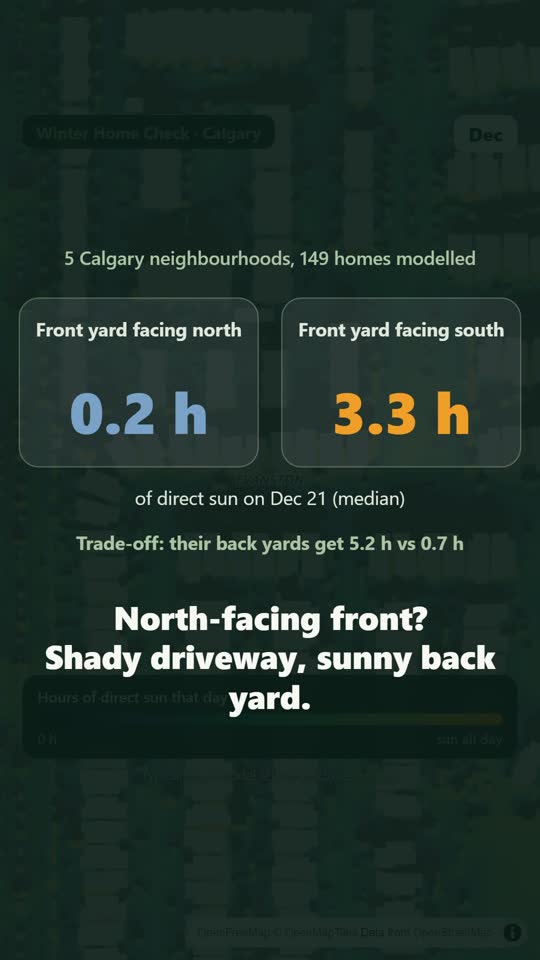
The pattern is clear: the sunny side of the lot flips with the direction the house faces. You get a sunny back yard or a sunny driveway; on a typical suburban lot you rarely get both in midwinter.
Saskatoon shows the same thing at the front: in our sample of 150 homes, the median north-facing front yard got 0 hours of direct sun on December 21 and the median south-facing front yard 1.8 hours.
These are medians from a typical-year model, not measurements of any single yard. Trees, fences, garages and the neighbouring houses can shade a south-facing yard too, especially in older neighbourhoods with mature trees.
The pros of a south-facing back yard
- Winter sun where you actually spend time. A back yard with a few hours of sun in December feels very different from one that sits in shadow for three months.
- Earlier spring. Snow in the sun melts first. Lawns, gardens and play areas on the south side of a house are usually usable earlier in the spring than those on the north side.
- Gardening. Vegetables and flowers that need full sun do best in the south-facing part of the lot, and the growing season on the prairies is short, so every extra week counts.
- Sunny rooms at the back. Kitchens and living rooms that look onto a south-facing yard get low winter sun through the windows, which many people value in a long, dark winter.
- Snow piles at the back melt faster. If you shovel the patio or deck onto the lawn, those piles disappear sooner.
The cons of a south-facing back yard
- A north-facing front. The driveway, walkway and front steps sit in the house's shadow for most of the winter. Snow and ice there usually last longer and need more clearing. In our Saskatoon sample, north-facing front yards still had about 22 cm of snow in March, compared with about 16 cm for south-facing ones.
- Strong summer sun on the deck. A south-facing deck with no shade can be bright and hot in the middle of a summer day. Trees, a pergola or an awning are the usual answer.
- Not a guarantee. A tall neighbouring house, a garage at the back of the lot or a row of spruce trees can shade a south-facing yard in winter, when the sun is low. The direction alone does not settle it.
What about summer?
In June the prairie sun climbs to around 60° at noon, and that same 8-metre house casts a midday shadow of only about 4 metres. Almost every yard gets plenty of light in summer, and the difference between a north- and a south-facing back yard is far smaller than in winter.
What matters more in summer is the afternoon and evening: west-facing yards and decks get the long evening sun, and east-facing ones get the morning. If you picture yourself on the deck on a July evening, west matters. If you picture the kids in the yard in March, south matters.
East- and west-facing back yards
East and west fall in between. An east-facing back yard gets the morning sun and a west-facing one the afternoon. In midwinter the day is short and the sun is low, so neighbouring houses and trees decide much of what reaches the ground. These are the yards where checking the exact spot is most useful.
How to check a yard before you buy
- Visit, or look again, on a sunny winter afternoon. Where are the shadows? Which side still has snow?
- Look up: big trees on the south side of the yard, a tall house next door or a garage at the back can all block the low sun.
- Think about how you will use the yard: a garden, a play area, a deck for summer evenings, or a dog run.
- Do not forget the front: if the back faces south, ask how the driveway and front steps behave in winter.
On the LandMood map you can put one pin in the back yard and another on the driveway, then compare them in the Sun layer for December, March and June. The Snow spots layer shows where snow lasts longest.
Questions people ask
Is a south-facing backyard good in Canada?
For most people, yes. In winter the sun is low in the southern sky, so a back yard on the south side of the house gets what little direct sun there is, and snow there tends to melt earlier in spring. The trade-off is that the front of the same house faces north, so the driveway and front steps are shaded all winter.
Is a north-facing backyard bad?
It is shadier, especially from November to February, when the house itself shades much of the yard. In our Calgary sample, back yards of homes with a south-facing front got a median of 0.7 hours of direct sun on December 21. In summer the difference is much smaller because the sun is high. A north-facing back yard often comes with an easier, sunnier driveway at the front.
Does a south-facing backyard get too hot in summer?
It gets the most sun, but on the prairies the summer sun is high, so every yard gets plenty of light in June and the difference between a north and a south yard is smaller than in winter. Trees, a pergola or an awning are the usual ways to add shade where you sit. West-facing yards get the long evening sun, which is the hottest part of a summer day.
What is better, a south-facing or west-facing backyard?
It depends on how you use the yard. South-facing gets the most winter sun and the earliest spring melt. West-facing gets afternoon and evening sun, which is pleasant for summer evenings on a deck. East-facing gets the morning. In midwinter, how much an east or west yard gets depends a lot on neighbouring houses and trees.