
Winter house hunting in Saskatoon and Calgary: a checklist
Why a winter viewing tells you more
A winter viewing in Saskatoon or Calgary can show where a home's shade, snow and ice actually fall: note which way the front faces, whether the driveway and steps are in shade at midday, and where snow has piled up or melt water has refrozen. Then check the same home on a map for the months you cannot see.
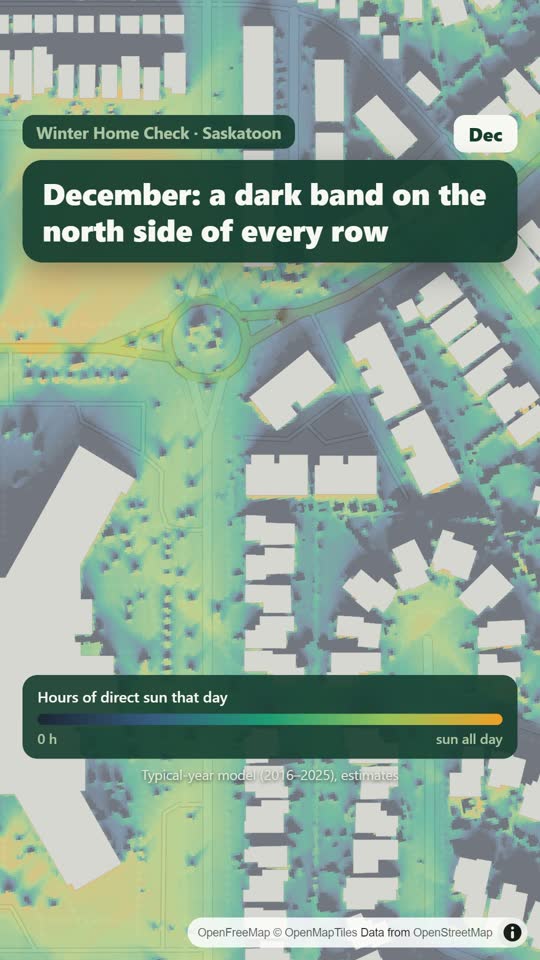
A summer viewing shows you the house at its best. A winter viewing shows you how it works in the season that lasts five months. On the prairies the sun is very low from November to February: at noon on December 21 it is only about 14° above the horizon in Saskatoon and 15° in Calgary, so a house throws a shadow about four times its own height. An 8-metre house casts a midday shadow of about 31 metres in December, and about 4 metres in June.
That is why the side of a house that faces north looks so different in winter. In our sample of 150 Saskatoon homes, the median north-facing front yard got 0 hours of direct sun on December 21, and the median south-facing one 1.8 hours. In 149 Calgary homes it was 0.2 against 3.3 hours, and the back yards were the mirror image: 5.2 hours behind north-facing homes, 0.7 hours behind south-facing ones.
Before you go
- Pick the time. If you can, view in the early afternoon on a sunny day, when the shade pattern is easy to read. If you only saw it in the evening, go back once in daylight.
- Know which way the house faces. A north-facing front means a shaded driveway and usually a sunnier back yard; a south-facing front is the reverse.
- Check the spot on a map. On the LandMood map you can put a pin on the driveway and another in the back yard, then look at December sun, March snow and April ponding compared with the ground around them.
Outside: the lot
- Shade. Which parts of the driveway, walkway and yard are in shade? Where is there still old snow when the rest has melted?
- The driveway. Is it clear to the pavement, or is there a packed or icy layer? Which way does it slope: toward the street, the garage or the house?
- Snow piles. Where do the sellers pile the snow, and which way will the meltwater run in spring? A pile on the high side of a shaded driveway is a common source of ice.
- Downspouts. Where do they empty? Look for ice at the bottom of downspouts, on the walkway or against the foundation.
- Steps and walkways. Are the front steps in the shade? Are there handrails?
- Trees and neighbours. Big spruce trees or a tall house to the south can shade even a south-facing yard in winter.
- Slope and low spots. Which side of the lot is lowest? That is where meltwater ends up in spring. On sloped lots, the direction the slope faces matters a lot: in our model, north-facing slopes got a fraction of the winter sun of south-facing ones.
Outside: the house
- Roof and eaves. Large icicles or thick ice along the edge of the roof are worth asking about; they can mean heat is escaping into the attic. Leave the diagnosis to the home inspector.
- Snow on the roof. On a cold day, a roof that has melted in patches while the neighbours' roofs are white can be another sign of heat loss.
- Foundation. Look for stains, cracks or ice where water runs down the walls.
- Garage. Is there water or ice on the floor near the door? Where does snowmelt from the car drain?
Inside
- Heating. Do the rooms feel evenly warm? Is any room noticeably colder, especially above the garage or at the corners of the house?
- Windows. Frost or condensation on the inside of windows, or water damage on the sills, is worth asking about.
- Basement. Look for water marks, efflorescence (white deposits) on the walls, a dehumidifier running, or fresh paint in one spot.
- Sump pump. Is there one? Is it running? Where does it discharge?
- Sunny rooms. Which rooms get winter sun? A south-facing living room or kitchen makes a real difference in December.
Questions to ask the sellers
- Does the driveway or the front steps ice up? What do you do about it?
- Where do you pile the snow?
- Has water ever pooled against the house or come into the basement or garage?
- How often does the sump pump run in spring, and where does it discharge?
- For a newer home: was the final lot grading approved by the city?
- What did heating cost last winter?
- Have there been ice dams or roof leaks?
These are questions, not verdicts. Treat the answers as a starting point for your home inspection, and confirm anything important with your inspector and your realtor.
Grading and drainage: what LandMood can and cannot tell you
LandMood shows, for a typical year (2016–2025), where on and around a lot snow tends to pile up, where meltwater and rain tend to collect in spring, and where melt water is more likely to refreeze, compared with the ground around it. Snow and water are shown as ranges, such as 0–5, 5–20 or 20–40 cm.
It is not a survey, an inspection or an engineering assessment, and it cannot see the inside of a house, the downspouts or the sump pump. Use it to know where to look and what to ask, then check those spots in person.
After the viewing
- Compare your notes with the map: was the shaded, snowy spot on the map the one you saw?
- If you are choosing between two or three homes, put a pin on each one and compare them side by side.
- Write down the answers to the questions above while you still remember which house was which.
Questions people ask
Is it a good idea to look at houses in winter?
Yes. Winter shows things a summer viewing hides: which side of the house is in shade, where snow piles up, whether the driveway ices, how the roof sheds snow and how warm the house feels. Snow does hide the lawn, the grading and the roof surface, so ask about those and leave room for the home inspection.
What should I look for when viewing a house in winter?
Look at the shade on the driveway and yard, icicles and ice build-up along the eaves, snow piles and where their meltwater will run, ice at the bottom of downspouts, frost or condensation on windows, and how evenly the house is heated. Ask the sellers about ice, spring water and heating costs.
What is a lot grading certificate or approval?
For newer homes, the city reviews how the lot is shaped so that water drains away from the house and does not flow onto neighbouring lots. Ask the sellers or your realtor whether the final lot grading was approved. It is a document check, not a guarantee; a home inspector looks at the grading on site.
Do I need to ask about the sump pump in Saskatoon?
It is worth asking in both Saskatoon and Calgary. Ask whether the house has a sump pump, how often it runs in spring, where it discharges and whether the basement has ever had water. Cities set rules about where sump pumps may discharge, so check the city's current rules for the address.