
North-facing vs south-facing house in Canada: what really changes in winter
The short answer
In Saskatoon and Calgary, a north-facing house usually has a shaded front yard and driveway through the winter, while its back yard is more likely to get winter sun; a south-facing house is the reverse. How much sun a yard actually gets also depends on the house's own shape, neighbouring houses and trees.
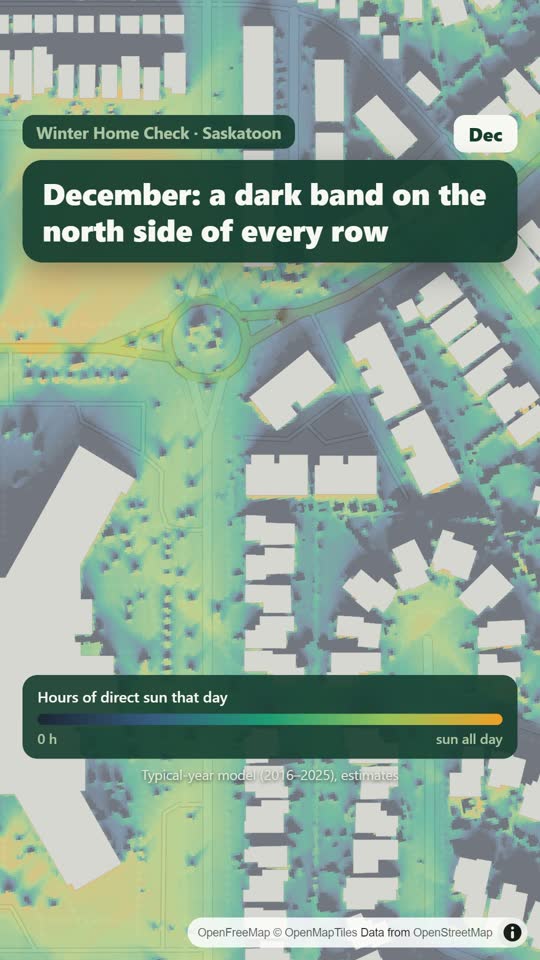
In a prairie winter the sun is very low. On December 21 it rises only about 14° above the horizon at noon in Saskatoon and about 15° in Calgary. At that angle a shadow is roughly four times as long as the thing casting it: an 8-metre two-storey house throws a shadow of about 31 metres at midday in December, compared with about 4 metres in June.
So in winter, every house shades the ground on its north side for most of the day. If the front of the house faces north, that shaded side is your front yard, your driveway and your front steps.
What we measured
We used LandMood's model, which places the sun hour by hour over 1-metre public lidar of the real houses and trees (Natural Resources Canada) and ten years of weather (2016–2025). We sampled about 30 homes in each of five neighbourhoods per city and compared the front yard (the street side) and the back yard on the shortest day of the year.
Saskatoon (Evergreen, Stonebridge, Nutana, Lakeview, Willowgrove — 150 homes)
| Front yard faces | Direct sun on Dec 21 (median) | Snow in March (about) |
|---|---|---|
| North | 0 h | 22 cm |
| South | 1.8 h | 16 cm |
Of the 32 homes with a north-facing front, 27 got less than half an hour of direct sun in the front yard on December 21.
Calgary (Signal Hill, Tuscany, Mahogany, Hillhurst, Edgemont — 149 homes)
| Front yard faces | Front yard, Dec 21 | Back yard, Dec 21 |
|---|---|---|
| North | 0.2 h | 5.2 h |
| South | 3.3 h | 0.7 h |
Calgary shows the trade-off clearly: a north-facing front usually means a sunny back yard, and a south-facing front usually means a back yard that sits in shadow all winter.
These are medians from a typical-year model, not measurements of any one home. Individual homes vary with trees, fences and neighbouring buildings.
Watch: two houses, one street
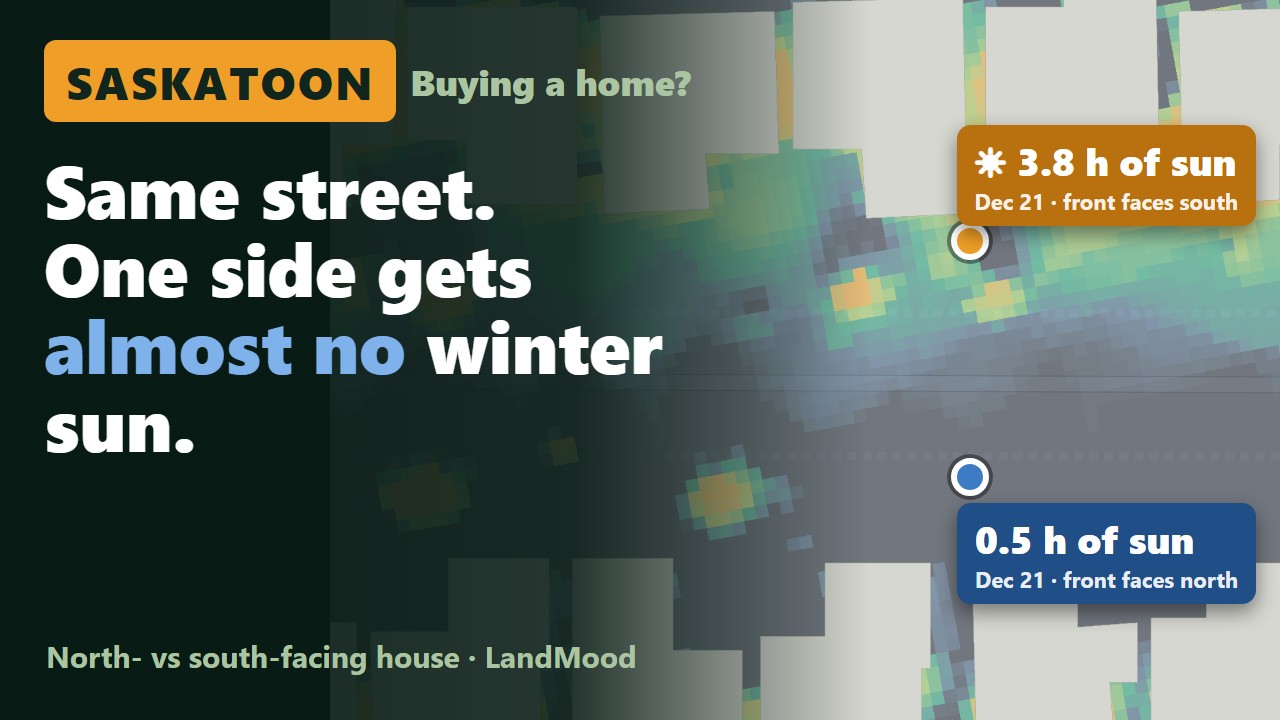
Two homes face each other across the same Saskatoon street. On the shortest day, the north-facing front yard gets about half an hour of direct sun; the south-facing one across the street gets almost four hours. The video walks through what that means for snow, melt water and ice.
Same building, two winters
The difference can be large over a very short distance. On the north side of one school building in Saskatoon, the model gives 0 hours of direct sun on December 21 and 20–40 cm of snow in January, because the wind also drops blown snow in the building's shelter. On the south side of the same building it gives about 7 hours of sun, 5–20 cm of snow in January, and 0–5 cm by March.
A house is smaller than a school, but the same physics applies to its front and back.
What it means when you buy
If the front faces north
- Expect the driveway, walk and front steps to stay snowy and icy longer, and to need more clearing and more grit.
- A driveway that slopes toward the street and sits in shade is the one to look at closely.
- The back yard often gets good sun all year: good for a garden, a deck or kids playing outside in March.
If the front faces south
- The driveway clears faster after each snowfall.
- The back yard may sit in the house's shadow from November to February.
Either way
- In older neighbourhoods with big trees, a south-facing yard can still be shaded. Look up when you are on site.
- Ask the sellers or neighbours: does the driveway ice up? Where does the snow pile? Does the yard hold water in spring?
- If you can, go back on a winter afternoon. You will see the shade and the ice for yourself.
East- and west-facing homes
East and west fronts fall in between: the front yard gets morning or afternoon sun and the back gets the other half of the day. In midwinter, with the sun so low and the day so short, how much each side gets depends a lot on the houses and trees around it, so it is worth checking the exact spot.
Questions people ask
Is a north-facing house bad in Canada?
Not bad, but different. The front yard, driveway and front steps of a north-facing house sit in the house's own shadow for most of the winter, so snow and ice there last longer. The back yard of the same house usually gets the sun. Whether that is a good trade depends on whether you care more about a sunny back yard or an easy driveway.
How much sun does a north-facing front yard get in winter?
Very little. In our Saskatoon sample of 150 homes, the median north-facing front yard got 0 hours of direct sun on December 21; in Calgary (149 homes) it was 0.2 hours. South-facing front yards got 1.8 hours in Saskatoon and 3.3 hours in Calgary.
Does a north-facing driveway have more ice?
It usually stays snowy and icy longer, because it gets little or no direct sun to melt it between snowfalls. In our Saskatoon sample, north-facing front yards still had about 22 cm of snow in March, compared with about 16 cm for south-facing ones. Grading, drainage and how you clear it matter too.
Which direction should a house face in Canada?
There is no single best direction. A south-facing front gives you an easier winter driveway; a north-facing front usually gives you a sunnier back yard. East and west fall in between. Trees and taller neighbours can change the picture for any single home, so check the actual spot.