
Buying a house on a hill, a slope or near the river: what changes in a prairie winter
The short answer
On a hillside or riverbank in Saskatoon or Calgary, ground that faces north usually gets much less winter sun than flat ground and keeps snow and ice longer, while ground that faces south usually gets more. Which way the slope faces can matter as much as which way the house faces.
On flat ground, the house is what decides where the winter shade falls. On a slope, the ground itself does too. In December the sun is only about 14° above the horizon at noon in Saskatoon and 15° in Calgary, so a slope that faces north tilts away from the sun and can sit in shadow most of the day, even with no house on it. A slope that faces south tilts toward the sun and gets far more light than flat ground.
That difference shows up in snow, in ice on driveways and paths, and in how early a yard comes back to life in spring.
What we measured on slopes
We used LandMood's model, which follows the sun hour by hour over 1-metre public lidar of the real terrain, houses and trees (Natural Resources Canada) and ten years of weather (2016–2025). In parks and on riverbanks we took ground steeper than 8% and averaged the direct sun on December 21 by the direction the slope faces.
| Place | North-facing slopes | South-facing slopes |
|---|---|---|
| Edworthy Park, Calgary | 0.3 h | 4.0 h |
| Signal Hill, Calgary | 1.2 h | 6.3 h |
| Edgemont, Calgary | 1.1 h | 4.5 h |
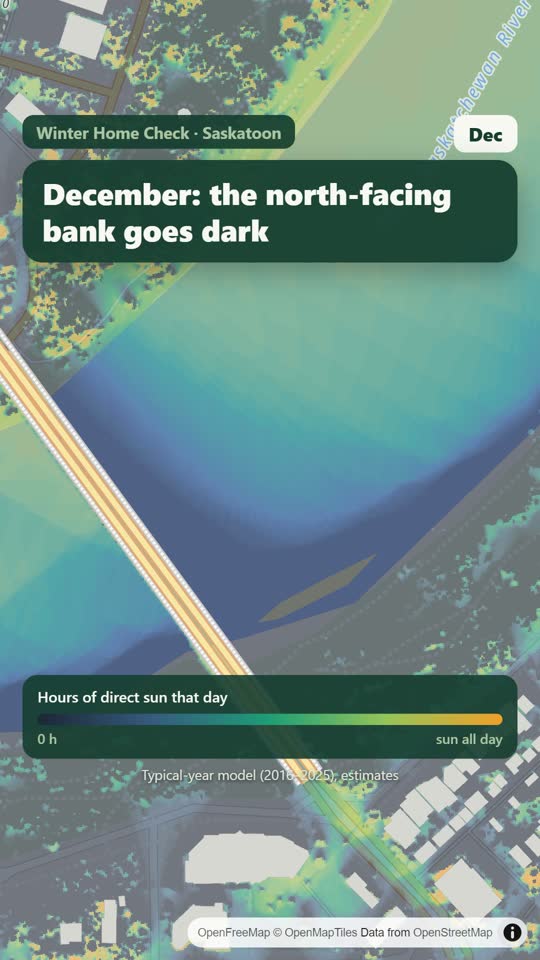
| Riverbank near Nutana, Saskatoon | 0.9 h | 4.4 h |
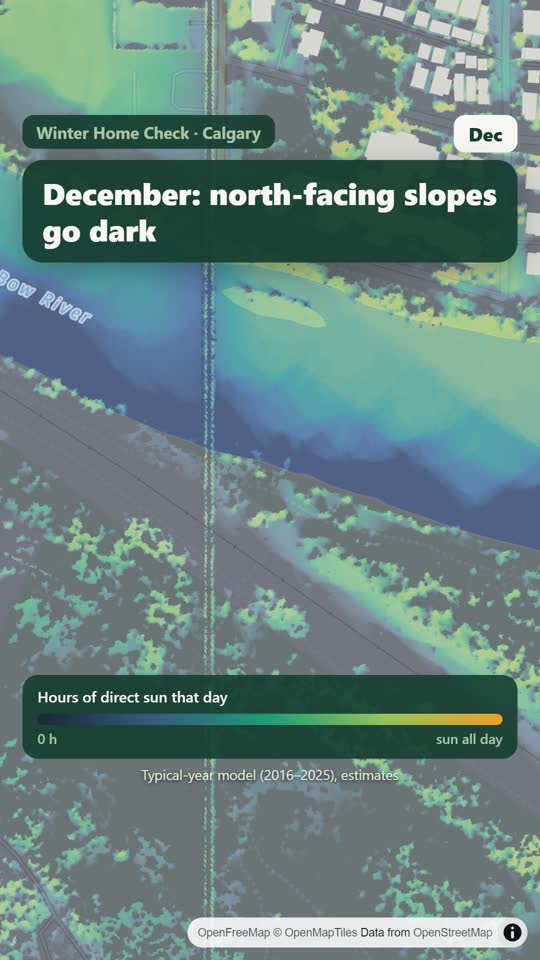
On gentle slopes the difference is small: along the edge of Nose Hill the ground was not steep enough to show a clear difference. The steeper the slope, the bigger the gap.
These are averages over public land, not measurements of any one lot. A particular house also gets shade from its own walls, its neighbours and trees.
Calgary hills and Saskatoon riverbanks
Calgary has many hillside communities, where streets climb the sides of valleys and ridges. Lots on the south-facing side of a hill get noticeably more winter sun; lots on the north-facing side can have back yards and driveways that stay snowy well into spring.
Saskatoon is mostly flat, but the South Saskatchewan River valley cuts through the middle of the city. Homes near the top of the riverbank, and the paths and parks below them, see the same pattern: the north-facing banks stay shaded and white long after the south-facing ones have melted.
Driveways and steps on a slope
The single most practical question on a sloped lot is the driveway.
- Which way does it face? A steep driveway in shade is much harder to keep clear than one in sun.
- Which way does it slope? A driveway that runs down toward the garage collects meltwater at the bottom. Ask whether there is a drain and whether water has ever come into the garage.
- Where does the meltwater go? Water from the roof, downspouts and snow piles runs downhill. If it crosses a shaded driveway or path it is likely to freeze again overnight; as a general rule, shaded and flat spots at the bottom of a slope are where ice lasts longest.
- The front steps and walkway. On a slope there are often more steps, and they are in the same shade as the driveway.
Water, grading and the river
On any sloped lot the low side is where water ends up in spring. That does not make it a problem, but it is worth asking about:
- How does the yard drain when the snow melts? Has water ever pooled against the house?
- For a walkout basement: is there a drain or a swale at the bottom of the slope? Where does the sump pump discharge?
- For newer homes, the city reviews lot grading when a house is built; ask whether the final grading was approved.
Near the river, also look up the address on the flood maps published by the city and the province, ask the sellers whether water has ever reached the property, and ask your insurance broker what coverage is available. LandMood does not assess flood risk; it shows where snowmelt and rain tend to collect at the scale of a yard, as a range compared with the surroundings.
Views, wind and shelter
Hilltop lots often have the views, and they are also the most exposed to wind. In a prairie winter that means more wind chill on the deck, and snow that blows off exposed ground and piles up in sheltered spots, such as the lee side of houses and fences. Lots lower on a slope or in a valley are usually more sheltered. LandMood's Wind layer shows how exposed a spot is compared with the land around it.
What to look for when you view a sloped lot in winter
- Which side of the house still has snow, and which has melted?
- Is the driveway clear, or does it have a layer of packed snow or ice?
- Where are the snow piles, and which way will their meltwater run?
- Are there stains, icicles or ice build-up at the bottom of downspouts or along the foundation?
- Walk the slope: is the lower side of the yard soft, wet or icy?
On the LandMood map, put a pin on the driveway and another in the back yard and compare them in the Sun layer for December, then look at the Snow spots and Ponding & ice layers for March and April to see where snow lasts and where meltwater collects compared with the ground around it.
Questions people ask
Is it a good idea to buy a house on a hill in Canada?
It can be, with your eyes open. The direction the slope faces matters a lot in winter: south-facing slopes get far more sun than north-facing ones, so snow and ice clear sooner. A steep driveway, where meltwater runs and how exposed the lot is to wind are the things to look at closely before you buy.
How much less sun does a north-facing slope get in winter?
Often only a fraction. In our model, ground on north-facing slopes steeper than 8% got about 0.3 hours of direct sun on December 21 at Edworthy Park in Calgary, against 4.0 hours on the south-facing side. At Signal Hill it was 1.2 against 6.3 hours, at Edgemont 1.1 against 4.5 hours, and on the riverbank near Nutana in Saskatoon 0.9 against 4.4 hours.
What should I check when buying a house near the river in Saskatoon or Calgary?
Look up the property on the flood maps published by the city and the province, ask the sellers whether water has ever reached the yard or basement, and ask your insurance broker what coverage is available for that address. On a riverbank, also look at which way the slope faces: the river valleys have steep north-facing banks that stay shaded and snowy much longer than the south-facing side.
Are walkout basements on a slope a problem in winter?
Not in themselves, but the lower side of the lot is where snowmelt and rain collect. Ask how the lot drains in spring, whether there is a drain or swale at the walkout, where the sump pump discharges, and whether anything has ever leaked. A home inspector can look at the grading on site.