
North-facing driveway: snow and ice in a prairie winter
The short answer
A north-facing driveway in Saskatoon or Calgary usually gets little or no direct sun from about November to February, so snow and ice tend to last longer on it than on a south-facing one. Neighbouring houses, trees and the slope of the driveway can make it better or worse.
From November to February the prairie sun stays very low. At noon on December 21 it is only about 14° above the horizon in Saskatoon and about 15° in Calgary. At that angle a shadow is about four times as long as whatever casts it: an 8-metre two-storey house throws a midday shadow of roughly 31 metres in December, against about 4 metres in June.
So in midwinter the ground on the north side of a house is in the house's own shadow for most of the day. If your driveway is on the north side, which is the case when the front of the house faces north, it gets little or no direct sun to melt the snow between snowfalls.
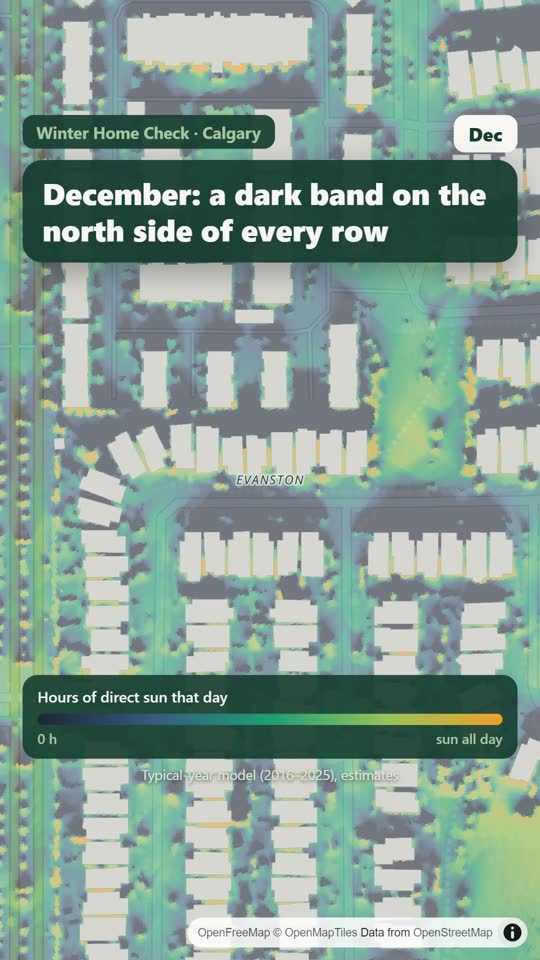
There is a short video of this on a Calgary street: two houses face each other, and on December 21 the north-facing front gets no direct sun while the one across the street gets 2.7 hours. Watch it on our Roxboro page.
How much sun a north-facing driveway gets
We used LandMood's model, which follows the sun hour by hour over 1-metre public lidar of the actual houses and trees (Natural Resources Canada) together with ten years of weather (2016–2025). We sampled about 30 homes in each of five neighbourhoods per city and compared the front yard, where the driveway usually is, on the shortest day of the year.
| North-facing front | South-facing front | |
|---|---|---|
| Saskatoon, direct sun on Dec 21 (median, 150 homes) | 0 h | 1.8 h |
| Calgary, direct sun on Dec 21 (median, 149 homes) | 0.2 h | 3.3 h |
| Saskatoon, snow on the ground in March (about) | 22 cm | 16 cm |
In Saskatoon, 27 of the 32 homes with a north-facing front got less than half an hour of direct sun in the front yard on December 21. These are medians from a typical-year model, not measurements of any single driveway; trees, fences and the house next door can change the picture for a particular home.
Why shade means more ice
Snow on a sunny driveway gets a small dose of melting on clear afternoons, even in a cold month, and a dark pavement surface helps. Snow in the shade does not. It stays until it is cleared, and once it is packed down by tires it turns into a hard, slick layer that is difficult to shovel.
Ice on driveways often comes from water that arrives from somewhere else: a roof that drips over the garage, a downspout that empties onto the pavement, or a snow pile on the high side that melts on a mild afternoon. Water that flows into a shaded spot is likely to freeze there again overnight. As a general rule, the flatter and more shaded a spot is, the longer melt water sits there and the more likely it is to refreeze.
The same physics shows on a larger scale. Beside one school building in Saskatoon, the model gives the north side 0 hours of sun on December 21 and 20–40 cm of snow in January, because the building also shelters it from the wind and blown snow settles there. The south side of the same building gets about 7 hours of sun and 5–20 cm of snow in January, and is down to 0–5 cm by March while the north side still has 5–20 cm.
Slopes make it more noticeable
A driveway that slopes is harder to manage than a flat one, and a sloped driveway in shade is the combination worth looking at closely. Ground that faces north stays shaded even longer than flat ground: in our slope sample, north-facing slopes at Edworthy Park in Calgary got about 0.3 hours of sun on December 21 against 4.0 hours on the south-facing side, and the riverbank slopes near Nutana in Saskatoon got 0.9 against 4.4 hours.
If a driveway slopes down toward the garage, ask where the water goes in spring and whether there is a drain at the bottom. If it slopes down to the street, a shaded, icy surface is one to be careful on with a car and on foot.
Practical ways to deal with a north-facing driveway
None of these are guarantees, but they are what experienced prairie homeowners tend to do:
- Clear early and clear to the pavement. Snow that is removed before cars pack it down rarely turns into ice. A thin layer left behind on a shaded driveway can stay for a long time.
- Think about where the snow pile goes. Put it where its meltwater drains away from the driveway and walkway, not on the uphill side where it will melt and run across.
- Watch the downspouts. A downspout or roof valley that drains onto the driveway is a common source of ice in shady spots. An extension that carries the water to the lawn or a drain can help.
- Use grit when it is very cold. Ordinary rock salt works poorly in deep cold, and much of a prairie winter is colder than that. Sand or grit gives traction whatever the temperature.
- Check the steps and the walkway too. On a north-facing house the front steps are in the same shadow as the driveway.
- Plan for the time. Some owners decide a snow blower or a clearing service is worth it for a long, shaded driveway; others enjoy the shovelling.
It is a trade-off, not a verdict
A north-facing driveway usually comes with a south-facing back yard. In our Calgary sample, homes with a north-facing front had a median of 5.2 hours of direct sun in the back yard on December 21, against 0.7 hours for homes with a south-facing front. For many buyers a sunny garden, patio or play area is worth a little more clearing at the front.
East- and west-facing driveways fall in between: they get morning or afternoon sun, and in midwinter how much they get depends a lot on neighbouring houses and trees.
What to look for when you view a house in winter
- Is the driveway clear, or is there a packed or icy layer the sellers have not been able to remove?
- Where are the snow piles, and which way would their meltwater run?
- Are there icicles over the garage door or the front steps, or stains where water drips?
- Does the driveway slope toward the garage, toward the house or toward the street?
- Ask the sellers or a neighbour: does it ice up, and what do they do about it?
On the LandMood map you can put a pin on the driveway, look at the Sun layer in December and January, and then check the Snow spots and Ponding & ice layers to see how the spot compares with the ground around it.
Questions people ask
Is a north-facing driveway worse for ice?
It usually stays snowy and icy longer. In midwinter the house shades the ground on its north side for most of the day, so a north-facing driveway gets little or no direct sun to melt snow between snowfalls. Meltwater that runs onto it from a roof or a snow pile can also freeze again in the shade. How you clear it and where the snow is piled matter as much as the direction.
North vs south facing driveway: what is the difference in winter?
Sun. In our Saskatoon sample the median north-facing front yard got 0 hours of direct sun on December 21 and the median south-facing one 1.8 hours; in Calgary it was 0.2 and 3.3 hours. A south-facing driveway often clears itself on a sunny afternoon; a north-facing one usually waits for the shovel or for spring.
How do I stop a north-facing driveway from icing up?
Clear it to bare pavement soon after each snowfall, before it is packed down by cars and feet. Pile the snow where its meltwater drains away from the driveway rather than across it, keep downspouts from emptying onto it, and use grit or sand on very cold days, when ordinary rock salt works poorly.
Should I avoid a house with a north-facing driveway?
Not necessarily. The same house usually has a sunny back yard, which many buyers value more. It is a trade-off: more clearing at the front in exchange for more sun at the back. Look at the slope of the driveway and where meltwater goes; a shaded driveway that slopes toward the house or the street deserves a closer look.